


Welcome back to the next issue of Escape Rooms Australia.
Welcome to 2026 I can’t believe we are in February already.
As we step into a brand-new year filled with fresh puzzles, hidden clues, and locked doors waiting to be opened, I’m thrilled to have you join us on this adventure. Whether you’re a seasoned enthusiast or planning your first great escape, this year promises to be packed with creativity, teamwork, and the joy of cracking that final code.
Lets celebrate the art of immersive puzzles, and share stories from the passionate community that brings these experiences to life. So, sharpen your wits, gather your team, and let’s make 2026 a year of unforgettable escapes together.
We are always open to feedback to help improve this magazine feel free to email us at:
Enthusiasts and GamesMasters feel free to send us your stories, we would love to hear about them.
Please feel free to share this magazine with fellow Escape Room Enthusiasts by clicking on the share icon.
Owners, please keep us updated on any new rooms you have opening, we would love to promote them for you.
The same button will allow you to bookmark and save to favourites.
Advertising
If you would like to advertise in the magazine email us at era@eludegames.com.au and we will send you an information pack.


Magicians Lair

Step into the Magician’s Lair, where nothing is as it seems and every card has a secret to tell. The mischievous Joker has stolen the suits from the deck, shattering the magic and plunging the lair into chaos.
In 60 thrilling minutes, your team must crack illusions, outsmart trickster puzzles, and uncover hidden symbols to restore the missing suits before the final curtain falls. Will you beat the Joker at his own game… or become the next trick up his sleeve?
Players: 2-6
Difficulty: 4 1/2
Suggested Ages: There is no restriction on age, however, the puzzles may be too demanding for those under 10. We do recognise that all children are different so please feel free to ask. 8005 0077
Duration: 60 Minutes

Jurassic Island

Deep in the Pacific, shrouded by storm and shadow, lies Jurassic Island, a place where the past is alive and more dangerous than ever.
Your mission is simple: infiltrate the island’s research facility and secure a priceless velociraptor egg before a rival team gets there first.
Intel confirms the island is without full power. When the mission begins, your first priority is to restore the grid and gain access to the Island’s computer system — without it, the egg remains out of reach.
Be warned, Predators still roam the island. The clock is ticking. In one hour, the extraction helicopter leaves… with or without you.
Get in. Get the egg. Get out.
Fail — and you become the prey.
Players: 2-6
Difficulty: 3/5
Suggested Ages: The Escape Reality experience is fun for everyone of all ages. However, players 15 and under must be accompanied in the room by a paying adult over the age of 18.
Duration: 60 Minutes

Sherlock: A Royal Murder Mystery
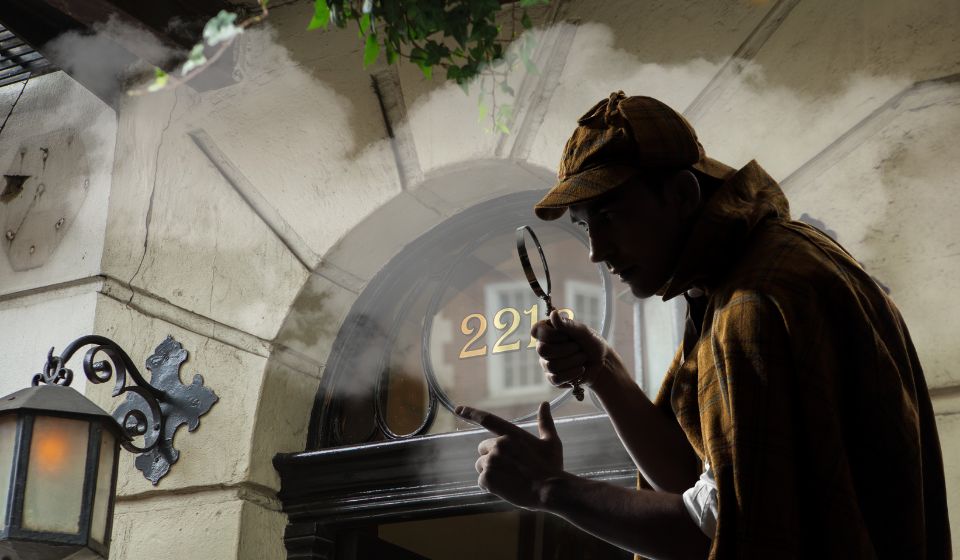
Step into the heart of the palace in this thrilling Victorian murder mystery. The King is dead — and only you can unravel the truth. Examine hidden clues, decode secret messages, and outsmart the suspects. With the help of Sherlock Holmes’, can you solve this intriguing murder mystery?
Players: 2-6
Difficulty: 4.5/5
Suggested Ages: 12 to 100+
Room Type: Mix of Locks & Tech
Accessibility: Not wheelchair accessible
Duration: 60 Minutes

Cosmic Rescue

A deadly alien virus has begun to sweep across Earth. Civilization is crumbling. Time is running out.
Hope rested on the TD-0501, a research vessel sent to Sirona to recover an antidote. But just days into the mission… communication was lost.
Now, you are Earth’s last chance. You are dispatched to locate the missing ship and retrieve the antidote, but the moment you set foot on Sirona’s surface… exposure began.
You have exactly 60 minutes before the virus overwhelms your systems.
Find the ship. Secure the antidote. Escape alive.
The fate of humanity is in your hands.
Players: 2-6
Difficulty: TBA
Suggested Ages: We don’t recommend our escape rooms for children under 12 years as the puzzles can be too challenging. Children under 12 can participate if there is an adult in the room as well.
Duration: 60 Minutes

Pharaoh’s Tomb
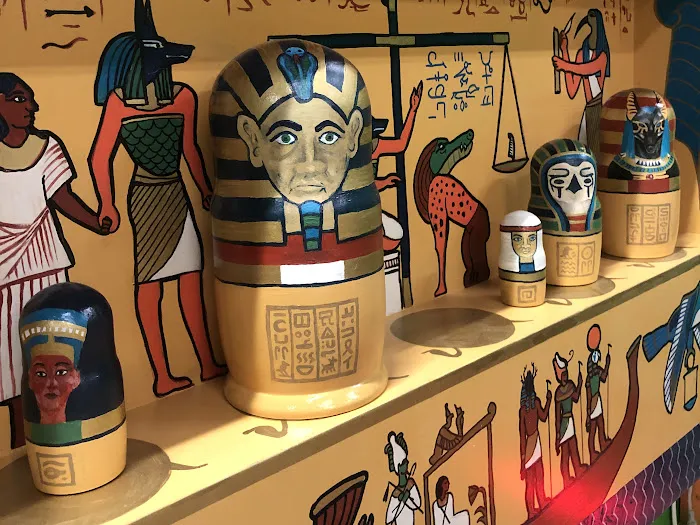
As you know, in ancient Egypt, the pharaohs were buried with their treasures. You are one of the archaeologists on a quest to acquire the artifacts when you realise you might not be alone in the tomb. Do you hear that noise? There’s definitely something else down here.
Players: 2-6
Difficulty: 4/10
Suggested Ages: Please note – our escape rooms are for ages 14 years and over due to mature themes. Children under the age of 16 require full adult supervision.
Duration: 60 Minutes


Operation: Sugar Shack

Welcome to the Sugar Shack ✨ Santa’s official training ground. To join Santa’s crew, recruits must pass the Elf Entry Test: a 60-minute challenge of wit, teamwork, and festive finesse inside a magical wonderland.
Prove your elf skills by tuning carol chimes, crack candy‑cane ciphers, and restoring the magical Gingerbread house. If you retrieve Mr Gingerbread man in time your team will have officially earned their peppermint stripes!
Players: 2-5
Difficulty: 2/5
Suggested Ages: Recommended for all ages
Duration: 60 Minutes

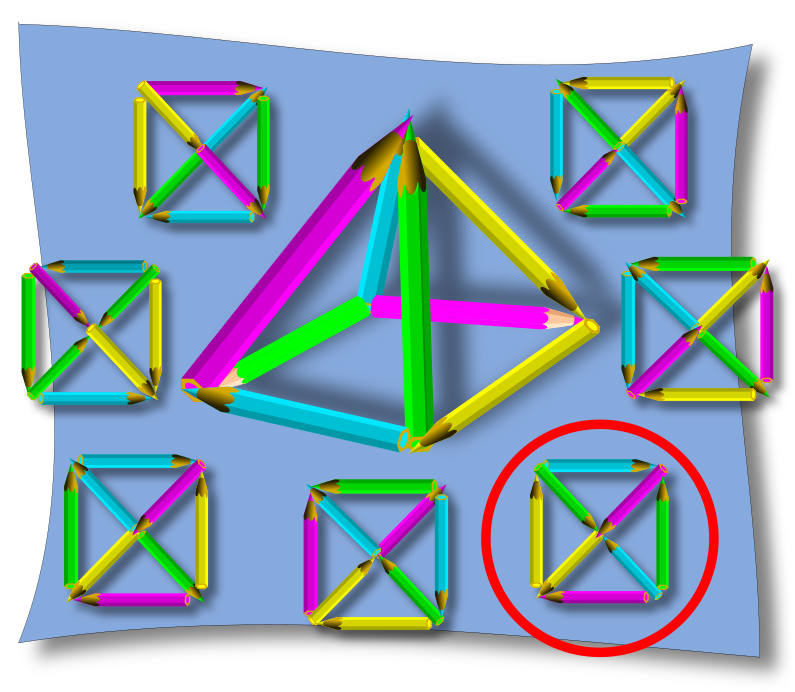
Click Image for Answer

The Adventure of the Crying Detectives
In this edition, we are going to look at possible reasons for why teams may fail to escape a room on time:
- The room was the problem;
- The team was the problem;
- An individual was the problem; or
- The Games Master was the problem.

Why would the room be a problem?
One issue could be in the room’s design: is the room too difficult, and if so, why? If no team can solve a particular puzzle, then the problem is the puzzle. A designer may think it’s a great puzzle (and be correct), but if it can’t be solved then you don’t have a good product.
Does the room lack sufficient signposting: do the clues lead logically to solutions and a location for the answer? Or is the room just too busy – should some puzzles get removed, or should the time limit be extended?
Why would the team be a problem?
Possibly the most common predicament: have the team simply chosen a room beyond their collective ability? Every Games Master has seen a fresh new team come in and book the most difficult room available. Despite a lack of experience, the combined ego of the group has determined that they know best and can solve anything. Good luck.
Alternatively, a team may just consist of friends mucking around and having a great time regardless of how well they go. If they’re all invested at the same level then this is a good thing.

Why would an individual be a problem?
If the attitude or actions of one player are vastly different to the rest of the team, this can have a very negative impact on their overall experience. Is one person sabotaging the rest – either intentionally or otherwise? Has one player hogged items, or not shared information, or is just having their own little tantrum? Adults as well as kids are more than capable of this. Or has it manifested through anger or aggressively forcing their ideas on the team to its detriment?

Why would the Games Master be a problem?
This column makes no secret of the importance of the Games Master. The GM is a cheerleader, counselor, social psychologist and spin-doctor all in one. They can bump up an average day into a great experience, but they can also go missing and leave teams flat at their departure.
Beforehand: assess the team. Not just asking how many escape rooms they have collectively done, but also where (it helps to have played a variety of rooms to know how they stack up in difficulty) and to try push them into a more appropriate room if possible. Reframe their objective to “do as much as you can” in the time assigned, not just “you have to escape”.
Inside: play your hints right. Read the room and don’t bruise any egos as you go to help with their ‘flow’. And don’t just disappear and leave them to struggle.
Afterwards: find individual highlights for each player to give them a ‘hero’ moment and boost everyone up for their team so they leave on an emotional high, instead of just “thanks, bye”.

Problems As A Puzzle
Most of the above issues can be covered by ending the experience with a debrief so good that the team comes back again (our ultimate goal). Avoid the word ‘fail’ and cheer for the effort, not the outcome. Ultimately, not everyone has to win. But we can be delicate and friendly in letting them lose.

Talking Gibberish
This simple grid-based cipher will have you babbling apparent nonsense to send out secret messages.
Gobbledigook
What we are doing in this edition is essentially taking the concept of a Polybius Square cipher (as seen in a previous edition — ERA Mag Apr23 — or knock code, but instead of being left with pairs of numbers, we will have pairs of letters that can actually be read out loud to form what seem like words.
Firstly set out all the alphabet in a five by six grid (below we’ve thrown in some punctuation just to fill the space). Then frame it with the five vowels above and below (on the x axis), and choose six consonants for the left and right (on the y axis). The order of these sets of letters is not important, but it is best to chose consonants that are very distinct (maybe avoid using both ‘G’ and ‘J’ on the same grid).
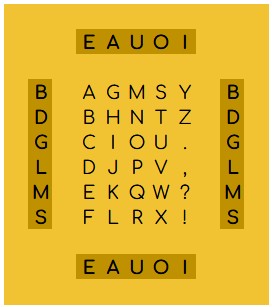
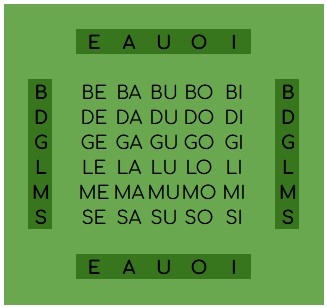
Each letter is then represented by a pair of letters like this:
Singing Like A Lunatic
Let’s use ‘babble’ as our example. First find ‘B’ on our grid, which is at the intersection of ‘D’ and ‘E’, giving us B=DE. ‘A’, just above it, gives A=BE. Completing the rest of the word gives us this:

So to convey the word ‘babble’ we can say the totally-nonsensical-but-totally-plausible-as-words DEBEDEDESAME. Which, obviously, we would read out as “dee bee dee dee saa mee”. It is crucial to this cipher that we enunciate each two-letter reference as a separate syllable and not try and blend them together. So don’t read this message out as “deeb deed same” or something like that.
Buzzing In Our Ears
To decipher, we need to take any syllable presented and separate it back into its consonant and vowel parts to give the grid reference.
Have a go at decoding this handsome fellow:

Endless Play
As this concealment method lends itself to the auditory format, be alert for spoken messages in your Escape Room. As always, a guide will be provided somewhere, and in this instance you should also get some writing material to take notes. Hopefully any designer using this also makes a distinction between vowel sounds: will ‘SI’ sound like ‘see’, ‘sigh’ or a Spanish ‘si’? Will ‘GU’ sound like ‘guh’ or ‘goo’?
Here’s one for you to figure out with our grid above:

Happy escaping!